
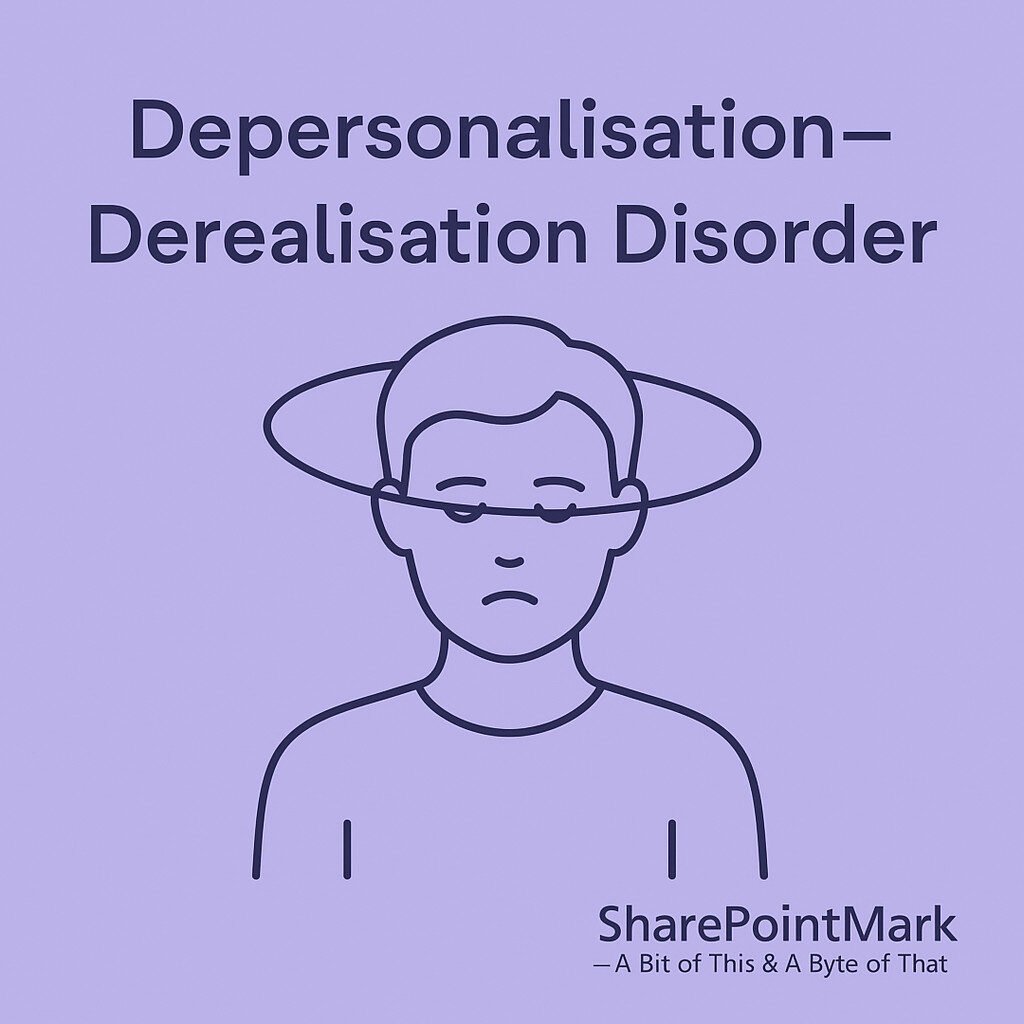
Day 62 - Depersonalisation–Derealisation Disorder
Most people have moments when the world feels strange or dreamlike. It might happen after too little sleep, during intense stress, or when caught in a difficult conversation. For people living with depersonalisation–derealisation disorder (DDD), these experiences are not fleeting or occasional. They are persistent, distressing, and can be overwhelming. The result is a feeling of disconnection either from yourself or from the world around you.
🧠 Depersonalisation
This is the experience of feeling detached from yourself. People may describe it as if they are watching their own life from the outside, as though they are observing themselves in a film or mirror. They might not feel ownership of their body, or they may feel like their thoughts are not their own.
🌍 Derealisation
This is a sense that the outside world is unreal. Colours can look flat, sounds can feel distant, or the environment might appear foggy or artificial. Both depersonalisation and derealisation can happen together or separately, and the experience can last minutes, hours, or longer.
While many people have had short episodes of disconnection, what makes this disorder different is how intense, recurring, and disruptive the feelings are. They interfere with daily life and create anxiety, fear, and confusion. People with the condition usually recognise that their perceptions are altered. They know that what they are feeling is not literally real, but that does not make it less distressing.
🔎 Causes
The exact cause of DDD is not fully understood, but research suggests a strong connection to trauma, stress, and anxiety. Many people living with the condition report a history of childhood adversity, while others link it to periods of overwhelming stress or depression. Dissociation in this context is thought to be the brain’s way of protecting itself. By creating distance between a person and their experiences, the mind reduces the impact of overwhelming emotion.
Biological factors also appear to play a role. Studies have identified differences in the brain areas that manage perception, self-awareness, and emotional regulation. This may help explain why some people experience such strong feelings of detachment. Importantly, DDD is not the same as psychosis. People with this condition do not lose touch with reality in the sense of believing things that are not true. Instead, they are painfully aware of the distortion in their perception, which can make the experience even more unsettling.
💭 What Does It Feel Like?
Trying to describe what the disorder feels like is one of the hardest challenges. People use phrases like:
- “It’s as if I am watching my life through glass.”
- “I feel like a stranger in my own body.”
- “The world looks flat, colourless, or dreamlike.”
- “It feels like I am moving on autopilot.”
These experiences are often deeply isolating, especially when friends or family cannot relate. The person knows they are physically present, but it does not feel real. That mismatch between reality and perception fuels frustration and fear.
🏠 Daily Impact
Living with the condition has a profound impact on daily life. Tasks that others might find simple, such as reading, working, or chatting with friends, can feel exhausting. Concentration slips, motivation dwindles, and the constant background of unreality makes everything harder. Relationships may suffer because the person finds it difficult to explain what is happening. Others may misinterpret the withdrawal as disinterest or coldness. The truth is that keeping up appearances while feeling detached can be exhausting.
Some people try to snap themselves back into the moment by using grounding techniques. They might pinch their skin, hold ice, listen to loud music, or focus on physical sensations to reconnect with the present. Sometimes these work, but not always. The cycle of anxiety, detachment, and exhaustion can continue for days or weeks, leaving people desperate for relief.
🚫 Stigma and Misunderstanding
A major difficulty is the lack of understanding and awareness in wider society. Because depersonalisation–derealisation disorder is less widely known than depression or anxiety, many people go undiagnosed for years. They may even be dismissed as dramatic, anxious, or seeking attention. Some are misdiagnosed with psychosis, which carries its own stigma.
Being told your experiences are not real, when the distress is very real, compounds the sense of isolation. Casual jokes about being “spaced out” or “out of it” trivialise what can be a life-limiting condition.
💡 Support Available
Treatment is possible, although there is no single solution. It often involves:
- Psychotherapy – Cognitive behavioural therapy and grounding-based approaches can help people reduce distress and manage symptoms.
- Medication – While there is no drug specifically for the disorder, medication for anxiety or depression can help.
- Self-help strategies – Mindfulness, grounding exercises, and structured routines may reduce symptoms.
- Peer support – Talking to others with similar experiences can reduce isolation.
Recovery looks different for everyone. For some, symptoms ease with time and treatment. For others, they come and go in cycles. The aim of therapy is often not to eliminate dissociation completely but to reduce its intensity and impact.
🤝 Supporting Someone with DDD
Supporting someone does not require expert knowledge. What matters most is respect and patience:
- Listen without judgement.
- Believe their experiences, even if they are hard to understand.
- Avoid dismissive comments such as “just snap out of it.”
- Remind them they are safe and that their feelings are valid.
- Encourage professional help if needed.
Simple acts like sitting together, talking calmly, being consistent can be incredibly grounding.
🗣️ Breaking the Silence
Awareness of depersonalisation–derealisation disorder (DDD) is growing, but it is still one of the lesser-known mental health conditions. Talking openly about it helps to break down misunderstanding and ensures more people get the recognition and support they need. By challenging misconceptions and sharing accurate information, we replace fear with understanding.
📢 Call-to-Action
Share this post with someone who may never have heard of depersonalisation–derealisation disorder. Awareness is the first step to compassion.
This is a conversation for us all – people struggling and those who want to help and support.
🧭 Follow the full journey: You can catch each day’s post right here and can follow along on LinkedIn, Instagram, or Bluesky. Thank you for joining me on this journey.
🔗 SharePointMark – A Bit of This & A Byte of That
#Dissociation #Depersonalisation #Derealisation #ItsOKtoNotbeOK #ItsOktoTalk #MentalHealth #LetsTalkMentalHealth #MentalHealthAwareness