
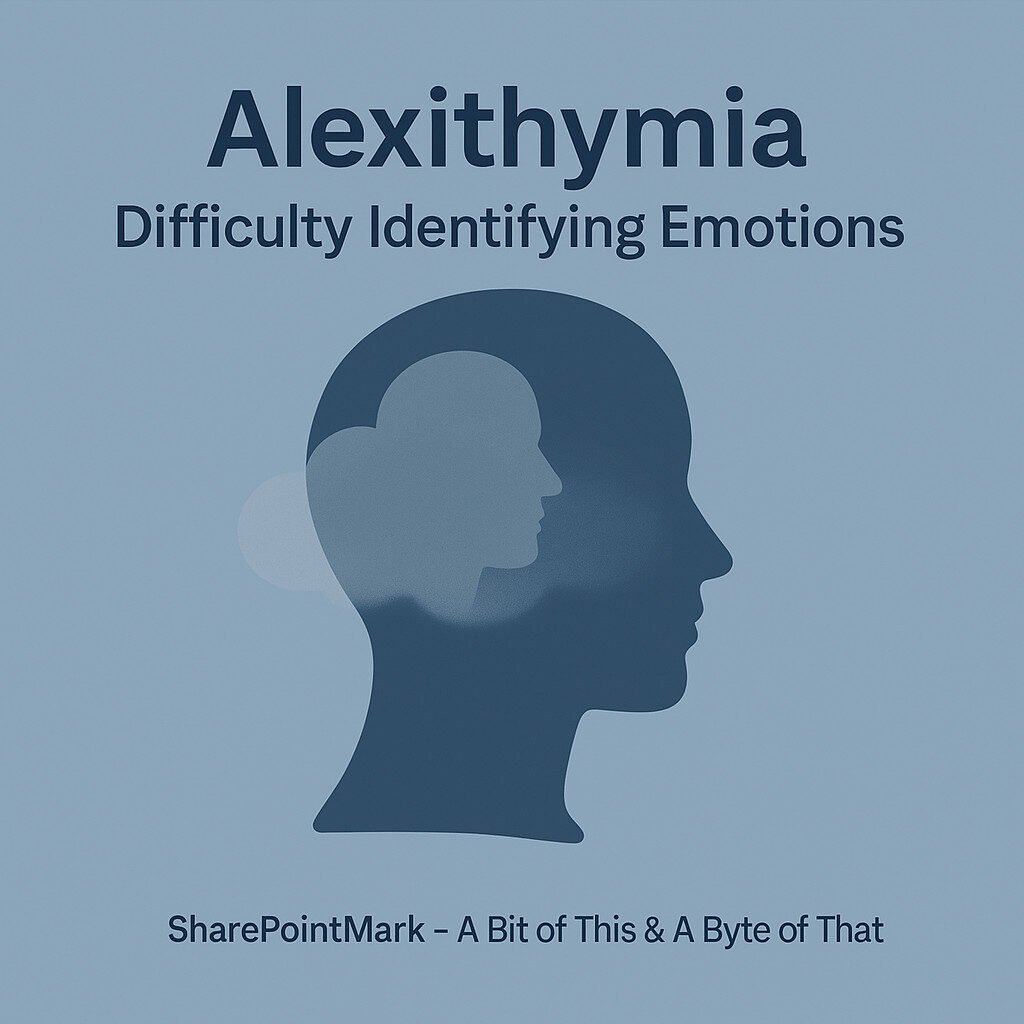
Day 80 - Alexithymia: Difficulty Identifying Emotions
🌫️ The Space Between Feeling and Knowing
The space between feeling and knowing can be hard to live inside. Imagine standing in front of a fogged-up mirror. You know your reflection is there; the outline, the movement, but the details are blurred. That is what alexithymia can feel like: emotions behind glass, visible but unreachable.
The word comes from Greek.
- “a” means without,
- “lexis” means words,
- “thymos” means emotion.
thus in its modern translation it means “No words for feelings“.
It is not emptiness. It is disconnection; a gap between what the body experiences and what the mind can name or share.
💭 When Emotion Has No Name
For many people, emotions arrive first as physical sensations. A tight chest. A heavy stomach. A restless energy in the limbs. But when they search for language, there is only silence or a single vague word like fine or bad.
Alexithymia is better thought of as a trait or style of processing that can shape daily life. In the general population, roughly one in ten people show moderate alexithymic traits. Among autistic people the rate is higher, and alexithymia often appears alongside anxiety, depression, or other conditions that influence emotion regulation.
This does not mean a lack of feeling. It means feeling without your own personal map.
🕰️ A Quick Check-In
Take thirty seconds now. Name three emotions you have felt today. Not what you did, but what you felt.
If words do not come easily, that is not failure. That is information. It suggests your inner language might need gentler listening. Try again later. The goal is noticing rather than accuracy.
🧠 How Alexithymia Shows Up in Daily Life
Because emotional awareness is subtle and internal, alexithymia often shows up indirectly.
- You might notice a vague sense of being unwell without a reason.
- You might have headaches, tight muscles, or digestive discomfort when life is stressful but not connect those signs to emotion.
- You may find your language narrows to a few safe words like fine, ok, stressed, rather than more precise terms like grief, worry, shame, frustration, hope.
- In conversations you may focus on facts and tasks rather than inner states.
- In therapy or self-reflection it can feel like a blank screen; the lights are on but the image will not load.
None of this makes you broken. It means your personal map is missing detail. Your personal maps can be redrawn.
💔 The Quiet Costs
When feelings do not have names, they are harder to regulate. If you cannot name it you cannot work with it.
Rumination can grow because the mind circles an experience without landing on what it is. Emotions that are not recognised often detour into the body. Tension, sleeplessness, headaches, and stomach pain can take the place of words.
Relationships can suffer because needs go unspoken and misunderstandings multiply. People may feel lonely in a room full of friends because they cannot translate inner experience into language others can receive.
Over time, unlabelled experience can erode confidence and identity.
If I cannot say what I feel, I may begin to doubt that I feel at all.
That doubt is painful and false. You do feel. The bridge to words just needs building.
📡 Fog, Frequency & Practice
Think of emotion like radio frequency. Many people tune in and hear lyrics; others catch only the rhythm.
Alexithymia is the static in between; the signal is present but the words are faint. Learning to listen again is possible. It begins with attention rather than analysis.
Start with sensation.
Several times each day, pause and scan your body. Notice heaviness, tightness, warmth, pressure, fluttering, restlessness, or numbness.
Describe the sensations plainly before you try to name a feeling. Tightness in chest. Heat in face. Fidget in hands. Let the description be simple and factual.
Name gently.
Choose a broad feeling word and try it on for size. Anxious. Sad. Irritable. Tired. Uneasy. If the guess does not fit, swap it for another.
Guessing is progress because it moves the mind toward language.
Keep a short log.
One or two lines is enough.
Example: Body cue -> possible emotion -> context.
- Chest tight before a meeting -> maybe anxious.
- Headache after argument -> maybe hurt or angry.
Over a week, patterns appear.
Find nonverbal expression.
If words are difficult, let the body speak first.
- Draw a shape for the feeling.
- Play music that matches the mood.
- Stretch, walk, or shake out the restless energy.
- Write a few lines of description rather than analysis.
Example: My sadness feels grey and heavy this morning. It sits in my chest like a stone.
You are not trying to be poetic; you are giving the feeling a doorway.
Practice affect labelling.
Say or write the phrase I feel … followed by a word, even if it is a guess. I feel nervous. I feel flat. I feel hopeful.
Research suggests that naming feelings, even roughly, can soften the intensity of the experience and help the thinking parts of the brain engage. Over time the guesses become more precise.
🌿 Therapy and Growth
Certain therapeutic approaches meet alexithymia on its own terms.
- Emotion-Focused Therapy (EFT) helps people access, tolerate, and label inner experience.
- Mindfulness builds space between reaction and reflection.
- Compassion-Focused Therapy (CFT) helps create inner safety so that feelings do not overwhelm.
- Cognitive Behavioural Therapy (CBT) can be adapted to include explicit work on identifying feelings and connecting them to thoughts and actions.
- Creative or movement-based therapies allow expression before words.
Research shows that with time and support, alexithymia can ease. In one study, around one in five people in treatment regained full emotional fluency.
🧩 What to Try This Week
These practices are small on purpose. Small is how new pathways are built.
1️⃣ Morning body note – on waking, write two lines that describe your body state and a possible feeling. Heavy eyes and a tight jaw -> maybe stressed. Lightness in the chest -> maybe calm or relief.
2️⃣ Midday emotion wheel – look at a simple emotion wheel and pick a word that seems close, even if it feels like a guess.
3️⃣ Evening debrief – note one moment when your body reacted strongly. What happened? What sensation? What might that signal?
4️⃣ Share one fragment – tell a trusted person a small piece of truth such as I felt off today and I am not sure why. Fragments count.
5️⃣ Choose a nonverbal action – a five-minute walk, a stretch, a song on repeat, a sketch. Let the body have a say.
🛡️ Gentle Boundaries
Emotional learning needs safety. Protect the basics – enough sleep, food, water, and movement.
Reduce the relentless pressure to perform at all times. Reduce noise. Set a time in the evening when messages or emails stop.
Boundaries are not selfish – they are the conditions for feeling to become thinkable.
🌙 Before You Go – A Small Exercise
Tonight, when the house is quieter, pause and ask two questions:
- What is happening in my body right now?
- What might that be trying to tell me?
If the answer is I do not know, stay there for a few breaths.
Uncertainty is not a failure. It is awareness beginning.
💬 Because Awareness Is the Start
Alexithymia does not mean absence of emotion.
It means your emotions speak a dialect you have not yet learned.
With curiosity and patience, the translation returns; one sensation, one word, one moment of honesty at a time.
This is a conversation for us all – people struggling and those who want to help and support.
🧭 Follow the full journey: You can catch each day’s post right here and can follow along on LinkedIn, Instagram, or Bluesky. Thank you for joining me on this journey.
🔗 SharePointMark – A Bit of This & A Byte of That
#Alexithymia #EmotionalAwareness #WorkplaceWellbeing #ItsOKtoNotbeOK #ItsOktoTalk #MentalHealth #LetsTalkMentalHealth #MentalHealthAwareness #SharePointMark