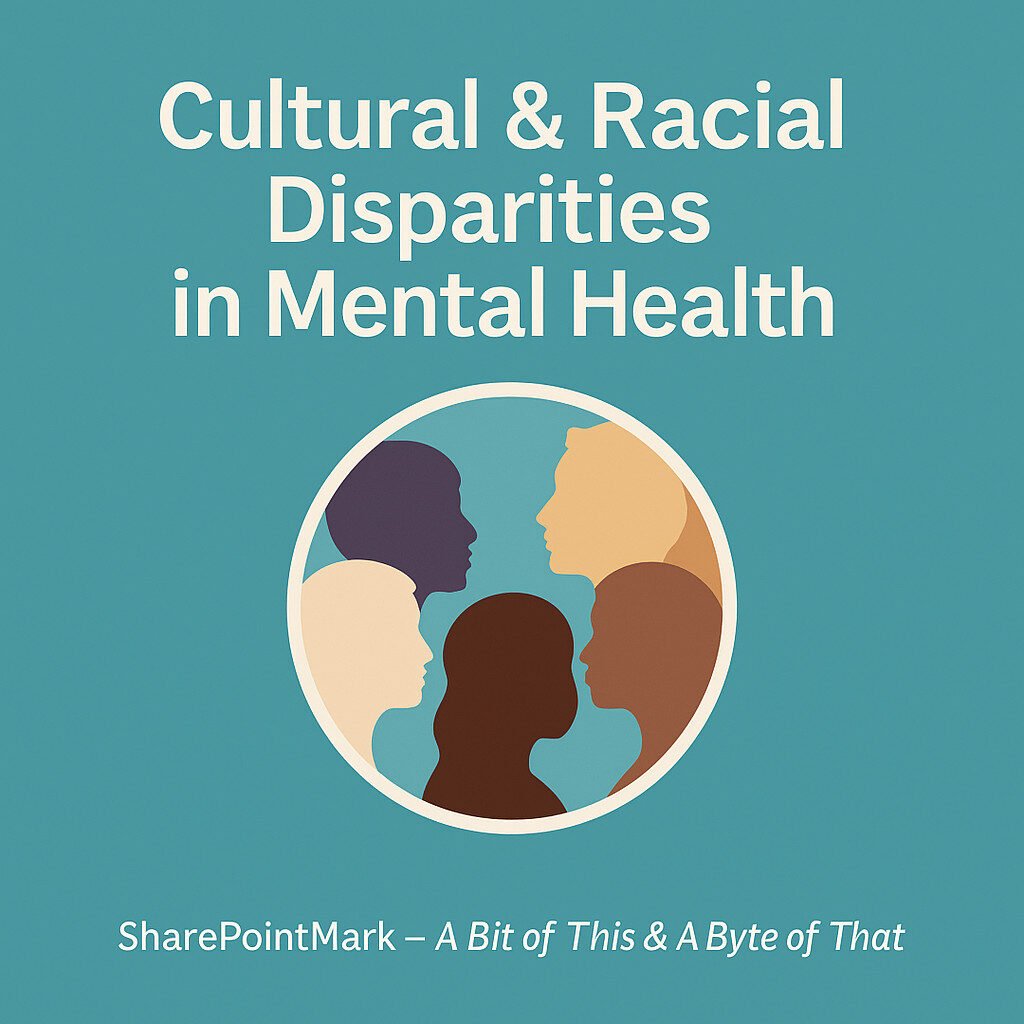
Day 89 - Cultural & Racial Disparities in Mental Health
Across the world, mental health care is shaped not only by science but by culture; by language, identity, belief, and access. Yet for millions of people, that culture also creates barriers:
- to being heard,
- to being believed,
- to being treated with the same dignity as everyone else.
🌍 Understanding the Divide
Cultural and racial disparities in mental health are not new. They exist in diagnosis rates, in treatment quality, and in the everyday experiences of people seeking help. Studies repeatedly show that Black, Asian, Indigenous and other minority ethnic groups are less likely to receive early mental-health support, more likely to face misdiagnosis, and often less confident that professionals will understand their background or lived experience.
This is not a question of resilience or strength. It is a question of equity.
When culture and race intersect with mental health, the differences become visible in subtle yet powerful ways; the stories we hear, the assumptions we make, and the systems we have built. A phrase such as “I’m anxious” might carry different meanings in different cultures. A physical symptom like chest pain might mask depression in one community and be dismissed as stress in another.
💬 Why Stigma Hits Differently
In many cultures, mental health is still treated as a taboo subject – something to keep behind closed doors. For some, seeking therapy is seen as weakness; for others, as a sign of family shame. Religious and community beliefs can add layers of guilt, with people encouraged to “pray it away” rather than seek clinical help.
In these environments, stigma doesn’t just silence people – it isolates them. Someone may endure years of anxiety or trauma before ever uttering a word, fearing judgement from within their own community as much as from society itself.
Language can also be a barrier. Terms like “mental illness” or “disorder” don’t always translate cleanly. In some languages, there is no direct equivalent for words like “depression” or “panic attack.” When people can’t name what they feel, they often internalise it, assuming the pain is personal failure rather than an illness that deserves compassion and care.
⚖️ The Systemic Imbalance
Healthcare systems, even in developed nations, were not built with cultural inclusion in mind. In the UK, for example, minority ethnic groups report higher detention rates under the Mental Health Act and lower satisfaction with care. Across global health services, representation among clinicians and researchers remains limited, leaving cultural nuance often misunderstood or ignored.
This imbalance is not intentional, but its impact is profound. Bias, whether conscious or unconscious, affects diagnosis, treatment, and empathy. A clinician who misreads cultural expressions of distress may mislabel symptoms as aggression, apathy, or non-compliance. The result is a cycle of mistrust:
- Patients feel unseen;
- Professionals feel unappreciated;
- Communities lose confidence in a system meant to protect them.
Across the NHS, there has been growing recognition of these inequalities. Research by Public Health England and the Race Disparity Unit highlights that structural inequities, historic mistrust, and limited community outreach contribute to poorer outcomes for ethnic-minority populations. Similar trends are seen internationally. The World Health Organisation’s Mental Health Atlas 2024 reports that countries with diverse populations often fail to provide proportionate representation within their workforce or culturally adapted interventions. Bridging this gap requires leadership commitment, better data, and consistent inclusion at policy level.
🧩 The Lived Experience Behind the Numbers
Behind every statistic is a story:
- The young woman who translates for her parents in therapy because no interpreter was available.
- The refugee who cannot explain trauma without reliving it in a language that isn’t his own.
- The professional who hides depression for fear colleagues will link it to stereotypes about his culture.
These are not isolated moments, they are daily realities. Mental health does not exist in a vacuum; it lives within identity, and identity shapes how people experience help, hope, and healing.
🚀 Awareness Must Become Action
Awareness alone cannot close the gap. Change must happen at three levels:
- Individual,
- Community, and
- Institutional.
1️⃣ Individual Understanding
Every conversation matters. Challenge assumptions. Listen before you label. Ask someone how they describe what they are feeling. Recognise that culture influences not only how symptoms are expressed but how healing is understood. Sometimes, listening is the most powerful act of inclusion.
2️⃣ Community Connection
Community leaders, faith groups, and local organisations can become bridges rather than barriers. When trusted voices speak about mental health, stigma begins to fade. Workshops, peer-support circles, and culturally tailored outreach can transform fear into understanding (ANDYSMANCLUB is a key example). Representation in campaigns matters; people need to see faces, languages, and stories that look and sound like their own.
3️⃣ Institutional Reform
Systems must evolve beyond one-size-fits-all. That means culturally informed training for mental-health professionals, interpreter services as standard, and research that truly reflects population diversity. It means reviewing data for bias, improving access for under-served communities, and funding prevention programmes designed with those communities, not for them.
🌈 Representation Saves Lives
Representation is not about politics, it’s about trust. When people see counsellors, nurses, and doctors who share their cultural background, they are more likely to engage honestly and stay in treatment. When research reflects multiple perspectives, interventions become more accurate and effective.
The Royal College of Psychiatrists has repeatedly emphasised that cultural-competency training improves engagement rates and reduces involuntary hospitalisation. In the United States, the National Institute of Mental Health notes that increased representation among clinicians directly correlates with better adherence to treatment plans. These examples underline a universal truth:
Trust is built through understanding and visibility.
True progress comes when cultural competence becomes cultural humility; the willingness to admit what we don’t know and learn from those we serve. Health systems that encourage collaboration between cultural mediators, interpreters, and clinicians see improved outcomes and satisfaction. Representation is not symbolic; it is strategic, measurable, and lifesaving.
💼 The Role of Workplaces
Employers are an often-overlooked part of this conversation. Workplaces that serve multicultural teams must build environments where mental-health support feels safe for everyone. That could mean multilingual resources, staff networks, and visible allies who champion inclusion. Mental-health training should include cultural context: how grief, burnout, or trauma might appear differently across backgrounds.
An inclusive workplace recognises that equality is not the same; it’s fairness shaped by understanding.
🤝 A Shared Responsibility
Cultural and racial disparities in mental health are not abstract statistics; they are reminders that compassion must be intersectional. If support only works for some, then it doesn’t truly work at all.
We each have a role:
- To educate ourselves,
- To question bias,
- To ensure that every person – regardless of race, faith, or culture – has access to the same understanding and care.
The more we listen, the more we learn that humanity’s shared need for belonging and peace outweighs every perceived difference.
💬 Call to Action
What’s one action you can take to make mental-health support more inclusive in your workplace?
This is a conversation for us all – people struggling and those who want to help and support.
🧭 Follow the full journey: You can catch each day’s post right here and can follow along on LinkedIn, Instagram, or Bluesky. Thank you for joining me on this journey.
🔗 SharePointMark – A Bit of This & A Byte of That
#Diversity #Equity #CulturalCompetence #WorkplaceWellbeing #ANDYSMANCLUB #ItsOKtoNotbeOK #ItsOktoTalk #MentalHealth #LetsTalkMentalHealth #MentalHealthAwareness #SharePointMark