
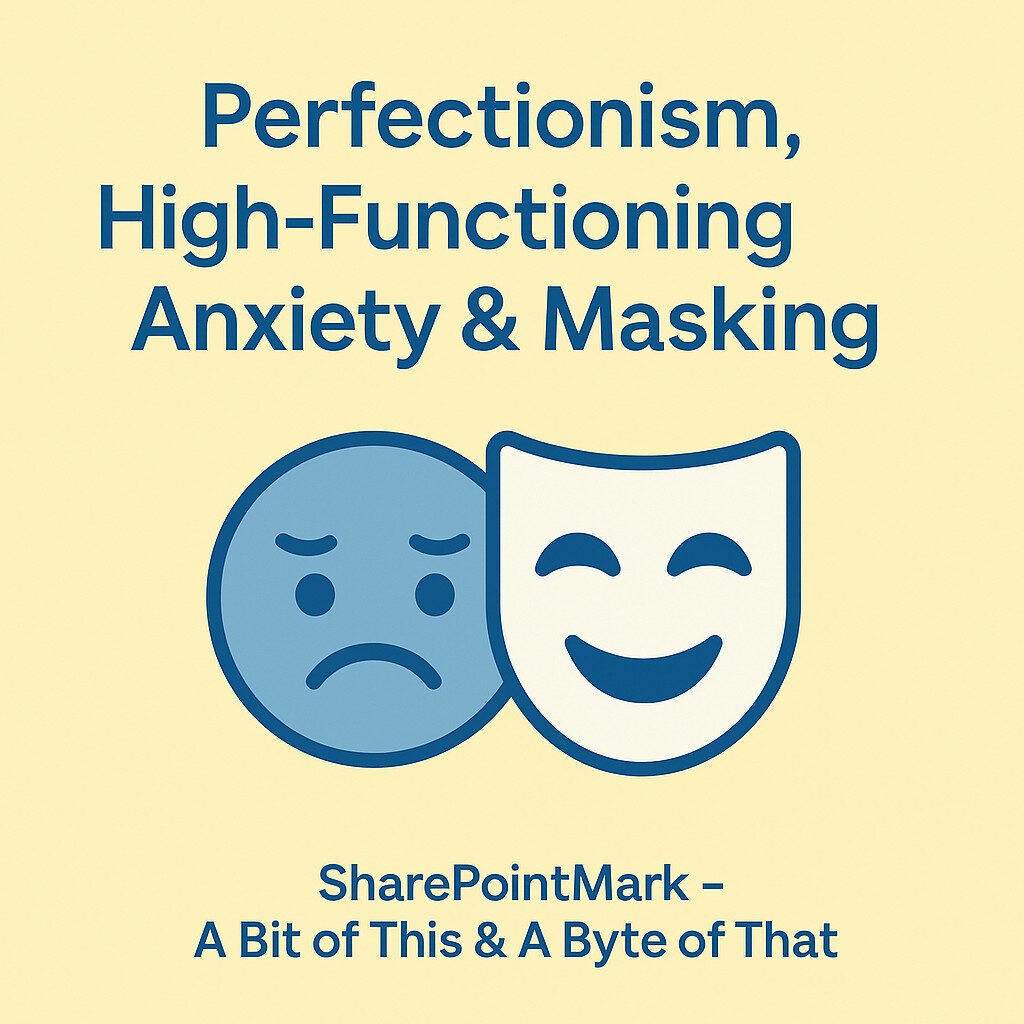
Day 79 - Perfectionism, High-Functioning Anxiety & Masking
We live in a culture that often celebrates excellence, relentless productivity, and perfection.
- “Do it right or don’t do it at all.”
- “Be flawless.”
These aren’t just slogans; for many, they’ve become a blueprint of self-worth.
But behind the mask of achievement often lies a more fragile reality: constant worry, self-criticism, and hiding how much you’re struggling. That’s where high-functioning anxiety, perfectionism, and masking intertwine.
In this post, I unpick how these forces feed each other, what the costs are, and how to begin unmasking toward greater self-compassion, balance, and emotional freedom.
🧩 What is Perfectionism? – why it’s not always “good”
Perfectionism isn’t a single thing. Psychologists often distinguish between adaptive (or positive) and maladaptive (or negative) perfectionism.
The difference lies in how those high standards are held and how they link to self-esteem and emotional well-being.
- Adaptive (High Standards): You set high goals, push yourself, but you can tolerate mistakes, learn from them, and keep perspective.
- Maladaptive (Discrepancy / Evaluative Concerns): Your sense of self hinges on flawless performance. Mistakes feel catastrophic. You ruminate, self-criticise, and fear judgement.
A 2025 study in Frontiers in Psychiatry found that High Standards sometimes positively related to life satisfaction, while Discrepancy – the gap between your “ideal” and your reality – was strongly tied to depression, anxiety, and stress.
In short: performance goals aren’t inherently harmful, but when your inner bar becomes rigid and tied to worth, distress often follows.
In a modern “achievement culture,” perfectionism is praised until it breaks us. When expectations become impossible to meet, self-worth crumbles and mental health suffers.
⚡ What is High-Functioning Anxiety?
It describes people who outwardly “have it together” but internally live in perpetual tension.
- On the outside: reliable, high achiever, always on top of tasks.
- On the inside: racing thoughts, fear of failure, constant worry, muscle tension, chronic fatigue, self-doubt.
Simplified to help you understand: Picture a swan gliding calmly across a lake – while its legs paddle furiously beneath the surface – you see the swan, but rarely see its legs.
If external performance is intact (or even exceptional), HFA often goes unnoticed. Yet the internal cost is profound: stress, burnout, emotional numbness, and erosion of joy.
🎭 Masking: Hiding the Struggle
Masking means hiding your internal distress behind a “performance face.”
It’s a survival strategy: maintain competence, avoid shame, minimise vulnerability.
Masking can look like:
- Overworking or overpreparing to avoid being “caught out”
- Keeping a smooth, calm exterior at all costs
- Denying fatigue or emotional pain
- Minimising your struggles (“I’m fine”)
- Overextending yourself to escape internal tension
Over time, masking disconnects you from true feelings, makes rest feel unsafe, and deepens the divide between “outer you” and “inner you.”
While often discussed in neurodiversity (e.g. autistic masking), the emotional cost applies to anyone hiding distress. The energy spent maintaining the mask can lead to exhaustion, identity confusion, and burnout.
🔄 How Perfectionism, HFA & Masking Feed Each Other
These forces reinforce one another in a painful loop:
- You hold perfectionistic standards.
- You strive to meet them, but internally endure constant anxiety.
- You fear being judged weak, so you mask the struggle.
- Masking hides your need for support, reinforcing perfectionism and intensifying anxiety.
Over time, mistakes feel intolerable, vulnerability is avoided, and tension becomes baseline.
The performance continues, but the cost grows heavier.
💔 The Hidden Costs
Living in this cycle has invisible consequences:
- Mental: depression, burnout, shame, chronic rumination
- Physical: high cortisol, tension, poor sleep, headaches
- Emotional: numbness, loss of authenticity, difficulty expressing feelings
- Relational: fear of trust, isolation, solo coping
- Identity: forgetting who you are beyond performance
🔍 Signs You Might Be Caught in the Cycle
- Mistakes or criticism feel catastrophic
- You rarely rest unless there’s “work to do”
- You chase external validation
- You feel unworthy when unproductive
- You suppress emotions
- You fear showing vulnerability
- You feel like a fraud even when succeeding
🌱 Steps Toward Unmasking & Transformation
1️⃣ Increase Awareness
- Pause for emotional check-ins (“What am I feeling just now?”)
- Notice where perfectionism shows up
- Journal without judgement
2️⃣ Practice Self-Compassion
- Speak kindly to yourself when things go wrong
- Allow “good enough” to be enough
- See vulnerability as courage, not weakness
3️⃣ Gentle Exposure to Vulnerability
- Share a small struggle with a trusted person
- Accept help; delegate
- Allow rest, observe what anxiety surfaces
4️⃣ Reframe Standards & Values
- Ask which goals come from fear vs meaning
- Focus on progress over perfection
- Stop chasing others’ expectations
5️⃣ Grounding & Regulation Tools
- Box breathing (4-4-4-4) or 4-7-8 breath
- Body scans, progressive muscle relaxation
- 5-4-3-2-1 grounding technique
- Movement and nature connection
6️⃣ Structured Worry Time
- Allocate 15 minutes daily for worry.
- When thoughts intrude, say “I’ll note that for worry time.”
- Contain the rumination — reclaim control.
7️⃣ Seek Therapeutic Support
- CBT: challenge perfectionist thinking
- ACT: values-driven acceptance
- Schema or Compassion-Focused Therapy: calm the inner critic
- Group therapy — safe spaces to unmask
8️⃣ Slow Integration
- Begin with small boundaries (don’t reply to emails after a set hour)
- Experiment with authenticity in safe spaces
- Reconnect with non-performance parts of you (play, creativity, rest)
💬 Breaking the Stigma
Over the next 48 hours, pause at least twice a day and ask:
“What’s the fear behind what I’m trying to do perfectly right now?”
Name it. Awareness is the first step to change.
✨ Gentle Reminder
Perfectionism, high-functioning anxiety and masking are powerful, but not permanent.
Healing doesn’t mean losing ambition; it means reclaiming peace from performance.
You deserve to rest, to breathe, and to be accepted for who you are; not just what you do.
This is a conversation for us all – people struggling and those who want to help and support.
🧭 Follow the full journey: You can catch each day’s post right here and can follow along on LinkedIn, Instagram, or Bluesky. Thank you for joining me on this journey.
🔗 SharePointMark – A Bit of This & A Byte of That
#Perfectionism #HighFunctioningAnxiety #Masking #WorkplaceWellbeing #ItsOKtoNotbeOK #ItsOktoTalk #MentalHealth #LetsTalkMentalHealth #MentalHealthAwareness #SharePointMark