
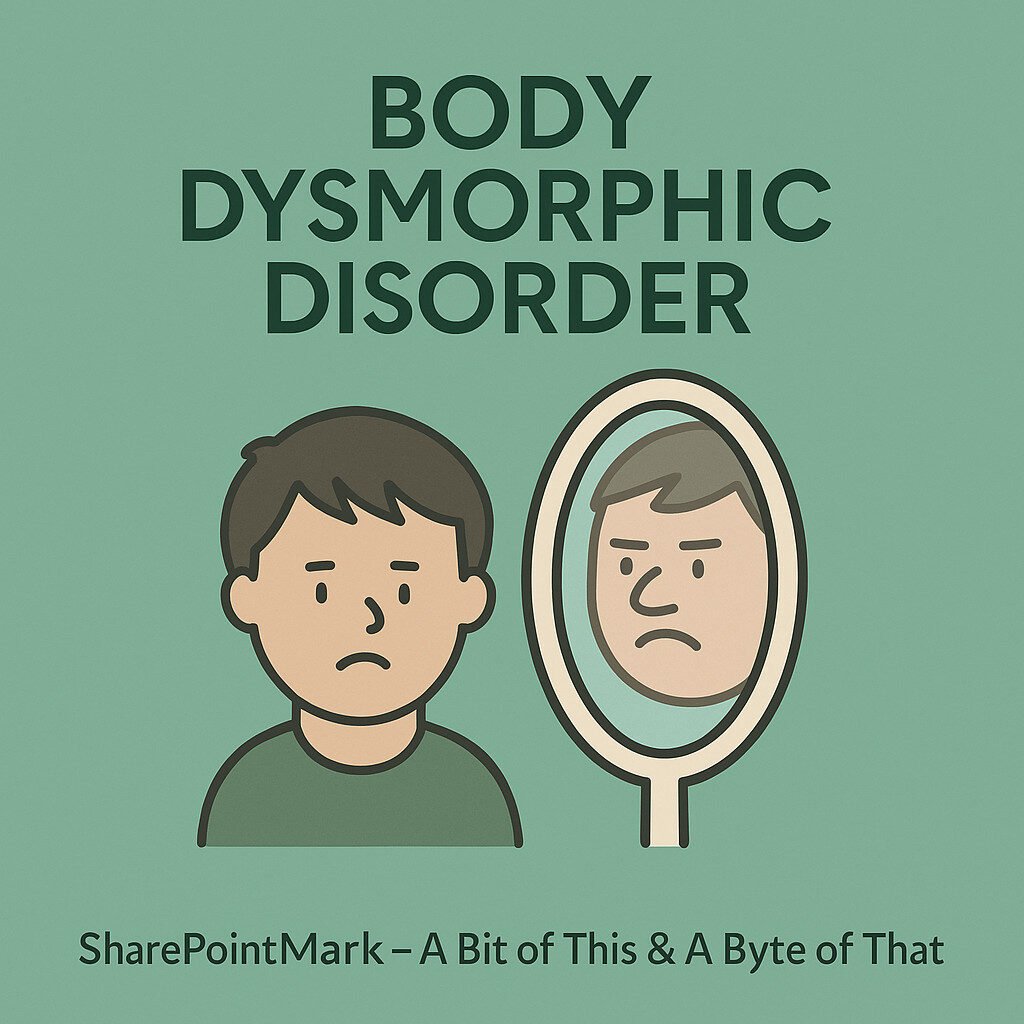
Day 81 - Body Dysmorphic Disorder
🪞 When the Mirror Lies
When you look in the mirror, what do you see?
Most people would say they see themselves – their face, their features, their expression in that moment. For someone living with Body Dysmorphic Disorder (BDD), that reflection is rarely neutral.
The mirror becomes a battleground, the reflection a distorted story that never seems to tell the truth. Body Dysmorphic Disorder is not vanity. It is not insecurity.
It is a serious mental-health condition where a person becomes fixated on perceived flaws or defects in their appearance – flaws that are often invisible to everyone else.
These thoughts can become intrusive, overwhelming, and consuming, disrupting work, relationships, and daily life.
BDD can affect anyone; men, women, young people, older adults. It does not discriminate by background or culture, although beauty pressures, social media, and societal ideals can amplify it.
The struggle is not about appearance itself but about perception and perception can be the hardest thing to change.
⚖️ Myth 1 – BDD is just low self-esteem
Truth: Everyone experiences moments of self-doubt, but Body Dysmorphic Disorder is far deeper. It involves obsessive thinking, repetitive checking, comparing, or even avoiding mirrors altogether.
People with BDD may spend hours analysing their features or trying to hide what they believe is wrong.
It can feel like living with a magnifying glass held over a single part of your body, with no way to put it down.
💉 Myth 2 – It’s about wanting cosmetic surgery
Truth: Many people with BDD might seek cosmetic procedures hoping to fix the perceived flaw, but this rarely helps. The issue lies not in the skin but in the brain’s processing of appearance.
After surgery, the anxiety often shifts to another body part.
Research shows that individuals with BDD often remain dissatisfied even after multiple procedures, because the underlying fear and distortion remain unaddressed.
🧍 Myth 3 – Only women experience BDD
Truth: While it is often portrayed as a female condition, BDD affects men too – sometimes in silence. Men may focus on muscle size, hair loss, or skin texture.
Muscle Dysmorphia, a related form, involves obsessive concerns about not being muscular enough, even in people who are already physically fit.
The shared struggle is internal – the inability to see oneself clearly.
💭 How it Feels
Imagine waking up each day with a single thought looping in your mind:
“something is wrong with me.”
You might stare into the mirror for hours, trying to fix, cover, or hide it, or you might avoid mirrors completely because the reflection feels unbearable.
- Compliments don’t reach you; reassurance doesn’t land.
- What others see as normal, you see as flawed.
People with BDD often describe feeling trapped between awareness and disbelief; they may know their worry is irrational, yet the feeling remains real. It can lead to isolation, depression, or even suicidal thoughts when the mental burden becomes too heavy.
These are not moments of vanity; they are moments of pain.
🧠 Understanding the Causes
Like many mental-health conditions, there is no single cause. Genetics, childhood experiences, perfectionism, trauma, and social pressure can all play roles.
Studies suggest that abnormalities in the brain’s visual-processing areas may contribute, meaning the way someone with BDD literally sees themselves may differ neurologically.
This isn’t imagination; it’s perception gone awry.
Social media and constant comparison also play powerful roles. Filters, idealised bodies, and curated perfection create impossible standards. For someone vulnerable to self-criticism, the digital world can amplify distortion.
But BDD existed long before selfies – the roots run deeper than culture alone.
🔍 Recognising the Signs
- Preoccupation with one or more perceived flaws that others do not notice
- Frequent mirror checking or, conversely, mirror avoidance
- Excessive grooming, skin picking, or attempts to hide appearance
- Constant comparison with others
- Seeking reassurance but rarely believing it
- Avoiding social situations due to shame or fear of judgment
These signs can appear subtle at first. Often, the person hides their distress so well that even close friends or family might not realise the depth of their struggle.
🌱 Living with BDD
Treatment is not about telling someone to “just stop worrying.” It is about learning to separate appearance from identity.
Evidence-based approaches such as Cognitive Behavioural Therapy (CBT), Exposure and Response Prevention (ERP), and medication can help reduce obsessive thought patterns and anxiety.
Therapy focuses on challenging distorted beliefs and building tolerance to uncertainty; not seeking perfection but finding acceptance.
Peer support also matters. Connecting with others who understand the daily fight can bring relief and validation. It reminds people that they are not alone, that the reflection in the mirror is not the enemy; it’s the story their mind has written, and stories can be rewritten.
📖 A Story Many Live Silently
“I know my face hasn’t changed, but when I look in the mirror, it’s like something cruel has shifted. I can’t explain it, and I can’t unsee it.”
“I thought if I could fix that one thing, I’d finally feel okay. But I never did.”
Their words capture the essence of BDD; the mind convincing the heart of a truth that isn’t true.
🪞 Reframing Reflection
Recovery begins with small acts of compassion.
- Limiting mirror time.
- Avoiding compulsive comparisons.
- Practising gratitude for what the body allows you to do rather than how it looks.
- Learning that worth is not reflected in glass but built in living moments – kindness, creativity, connection, laughter.
These shifts don’t happen overnight. They grow with patience and support. Every step toward acceptance is a victory against distortion.
🤝 How to Support Someone
If someone you know struggles with appearance concerns that seem excessive:
- Avoid reassurance or dismissing (“you look fine”) – it rarely helps.
- Focus on listening and empathy rather than fixing.
- Encourage professional help if anxiety is interfering with daily life.
- Remind them that they are seen and valued for who they are, not what they think they look like.
Support doesn’t require perfect words, only consistent kindness.
What would it mean to look in the mirror and see yourself as you are; not as your fears describe you?
Maybe healing starts not by changing the reflection, but by changing the story we tell about it.
This is a conversation for us all – people struggling and those who want to help and support.
🧭 Follow the full journey: You can catch each day’s post right here and can follow along on LinkedIn, Instagram, or Bluesky. Thank you for joining me on this journey.
🔗 SharePointMark – A Bit of This & A Byte of That
#BodyDysmorphicDisorder #BDD #ItsOKtoNotbeOK #ItsOktoTalk #MentalHealth #LetsTalkMentalHealth #MentalHealthAwareness #SharePointMark